
Findings from a Helio Genomics and UC Irvine collaboration, published in Genome Medicine, show that Multimodal Epigenetic Sequencing Analysis (MESA) of cell-free DNA improves non-invasive colorectal cancer detection over single-modality approaches.
Findings published in the open-access journal Genome Medicine.
Helio Genomics, an AI-powered precision cancer detection company, today announced that results from an important new research study have been published in the peer-reviewed journal, Genome Medicine.
The study is entitled “Multimodal Epigenetic Sequencing Analysis (MESA) of Cell-free DNA for Non-invasive Colorectal Cancer Detection.” This study was conducted as a collaboration between Helio Genomics, its sister company, and the Division of Computational Biomedicine at the University of California, Irvine.
“We are excited to partner with Helio Genomics in the development of MESA, a groundbreaking innovation in liquid biopsy technology that promises to transform the early detection and management of numerous human diseases.”
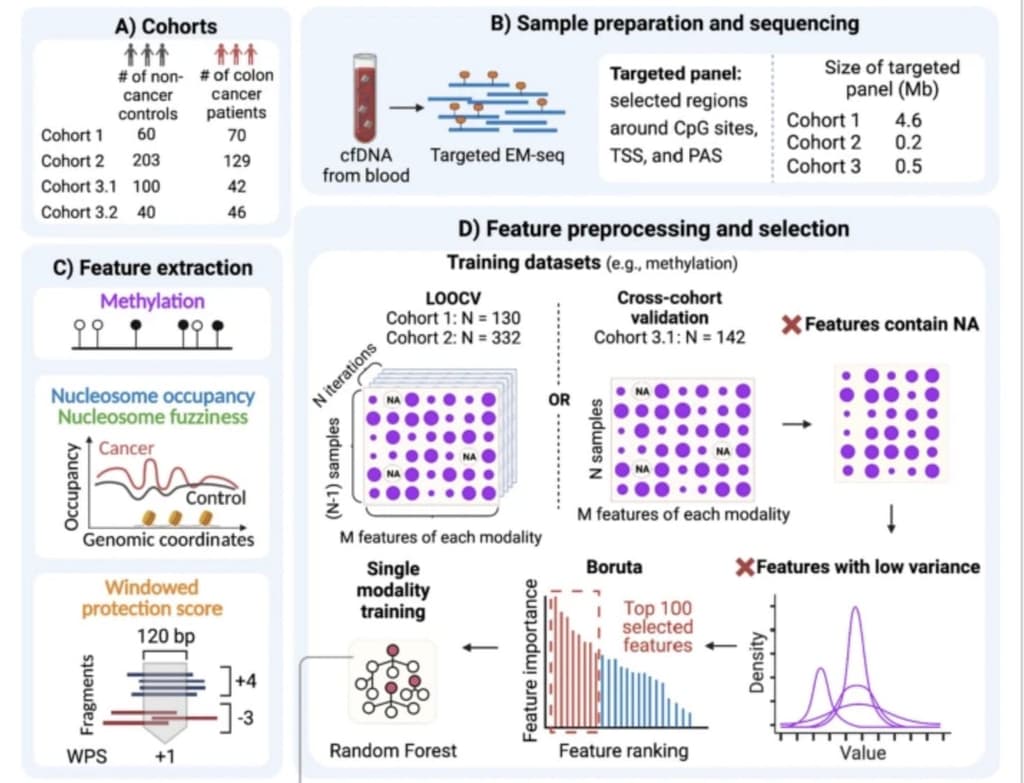
Applied to 690 cell-free DNA (cfDNA) samples from three colorectal cancer clinical cohorts, the novel MESA approach improved cancer detection when compared to traditional approaches that use epigenetic markers of promoter DNA methylation.
Key results of the study included:
- The MESA approach successfully captured both cfDNA methylation features and nucleosome organization information within a single assay.
- cfDNA methylation data captured in the MESA approach enabled detection of colorectal cancer.
- Nucleosome organization information (nucleosome occupancy and fuzziness) captured by the MESA approach also enabled detection of colorectal cancer.
- Integrating multimodal epigenetic features (cfDNA methylation, nucleosome occupancy, nucleosome fuzziness, and a window protection score as a measure of nucleosome positioning) by using MESA enhanced cancer detection when compared to any single modality alone.
- MESA was shown to be effective in multiple cohorts of patients, demonstrating the robustness of this multimodal approach.
A significant advantage of MESA is its ability to effectively combine four highly complementary epigenetic modalities: cfDNA methylation, nucleosome occupancy, nucleosome fuzziness, and a window protection score (WPS) as a measure of nucleosome positioning across gene promoters and polyadenylation sites.
The study found that MESA, by integrating these multiple epigenetic modalities, demonstrated superior accuracy for the detection of colorectal, liver and pancreatic cancers compared to models based on a single modality. As a result, MESA represents a major advancement in non-invasive cancer detection by leveraging comprehensive and complementary epigenetic profiles of cfDNA within a single assay.
The underlying discovery that methylation features, nucleosome organization features and fragmentation features can be combined to generate superior models is also the subject of U.S. and international patent applications.
“With the combination of Helio’s high throughput ECLIPSE platform for data collection and the MESA approach for data analysis, Helio is now in a remarkable position to not only identify many different features of cfDNA that are indicative of disease, but also to develop better models to identify early disease. These two advances will ultimately benefit patients through the development of more accurate, easy to use diagnostic tests that can detect cancers early, when more treatment options are available and curative treatment is more likely.”
Helio has also developed the HelioLiver test, a multi-analyte blood test designed to aid in the detection of liver cancers. MESA offers a flexible and sensitive approach to capturing and integrating a diverse range of epigenetic features in cell-free DNA (cfDNA) using a single experimental assay.
Read the MESA study report here: genomemedicine.biomedcentral.com/articles/10.1186/s13073-023-01280-6. It is also listed among our publications.
For information on Helio Genomics and its innovative solutions for early cancer detection, visit www.heliogenomics.com.
View the study in Genome Medicine.